
Start With People, Not Platforms – Seven lessons from Japan on making knowledge change stick

Most knowledge initiatives start with a platform: a new system, tool or governance framework. But technology alone does not make people share what they know. Drawing on Professor Naoki Ogiwara’s session at Knowledge Summit Dublin 2026 and case studies from Fujifilm Medical Systems and Hitachi-GE Nuclear Energy, this article sets out seven lessons for training, learning and knowledge managers, plus a 30-day experiment for testing the approach in practice.
The 2026 Workplace Skills That Matter Most

Skills are shifting fast, build the capability that drives performance, adaptability, and retention. As CEOs, CHROs, and site leaders, we are facing a simple truth: performance is no longer just a matter of having good people. It is about having the right skills at the right time, and a workplace system that helps those skills evolve as fast as the work does. LinkedIn’s Skills on the Rise 2026 (Europe) is a useful signal because it is grounded in year-over-year growth in skill acquisition and hiring success, comparing 1 December 2024 to 30 November 2025 with the prior year. That data-backed lens matters for CHROs and operations leaders who need to bet on capability, not hype. Below is what stands out, and how to turn it into better performance, continuous learning, especially adaptability and social learning, and higher engagement that drives attraction and retention. 1) The new basics: AI fluency and operational effectiveness Across the six European countries LinkedIn analysed (France, Germany, Italy, Netherlands, Spain, UK), AI-related skills appear as a top priority in each. In parallel, there is a widespread drive for organisational effectiveness, visible in demand for data-driven decision making and process optimisation. For Ops and Site Leads, this is the practical takeaway: the future is not only digital transformation. It is AI plus execution discipline. You can see that execution discipline reflected in the fast-growing skill clusters: What this means in practice: the organisations that outperform will not be those with the most training content. They will be the ones who can reliably convert data and AI tools into faster decisions, fewer defects, safer operations, and better customer outcomes, week after week. To quote Mariana Papacosta who provided this gem of an insight on a LinkedIn thread: AI has made doing cheap, but deciding expensive. 2) Digital foundations are quietly becoming table stakes Europe’s signal is not only GenAI. It is also the infrastructure underneath modern operations. Germany’s fast-growing skills include cloud environments, AWS and Azure, infrastructure as code, containerisation, and Linux. Spain highlights identity and access management (IAM) and modern development tooling. The UK emphasises cyber risk management and governance, risk and compliance (GRC) as part of operations and risk resilience. For operations leaders, this is about resilience: when digital systems run your plant, warehouse, service operation, or customer experience – then, availability, security, and control become front-line performance issues, not IT issues. 3) Human skills are not a nice-to-have, they are the performance multiplier One of the most consistent themes in the LinkedIn analysis is a rise in skills that make work work across functions and shifting priorities: This matters because the work is increasingly cross-functional: AI projects, productivity initiatives, safety improvements, and customer experience redesigns rarely succeed inside one silo. And it is not just a talent story. It is an execution story. 4) The meta-skill behind all of this: adaptability through continuous learning If you want one headline for 2026 workforce strategy, it is this: skills will keep moving. The World Economic Forum projects that, on average, 39% of workers’ existing skill sets will be transformed or become outdated between 2025 and 2030. That is why adaptability is not a soft theme. It is operational risk management. But adaptability does not scale through more courses alone. It scales through learning habits embedded in work, supported by social systems, teams, mentors, and communities that transmit know-how quickly. LinkedIn’s research on learning culture is especially relevant here: This is the bridge CHROs and Site Leads need: continuous learning is a performance system and an engagement system. 5) Why this matters now: engagement is fragile, especially in Europe Engagement is a leading indicator for productivity, safety, quality, and retention. Europe has consistently reported low engagement in major workforce surveys, which makes capability building harder because teams are already stretched. When engagement is weak, you do not just lose people. You lose discretionary effort, improvement ideas, peer support, and the energy required to adapt. So, the strategic goal is not train more. It is to build a workplace where learning, progress, and contribution are visible and valued. What CHROs and Operations Leaders should do next From a CEO’s perspective at Slick+, here are the moves that consistently separate organisations who improve capability from those who simply deliver training: The future workforce is not defined by one skill. It is defined by a stack: AI fluency plus data-to-decision, operational excellence, resilience, and human collaboration, powered by a culture where people learn continuously and socially, right in the flow of work. References 1. LinkedIn, Skills on the Rise 2026 (Europe), LinkedIn Pulse article: https://www.linkedin.com/pulse/linkedin-skills-rise-2026-fastest-growing-europe-5f4je/ 2. World Economic Forum, The Future of Jobs Report 2025, Skills outlook (skills disruption estimate): https://www.weforum.org/publications/the-future-of-jobs-report-2025/ 3. LinkedIn, Workplace Learning Report 2024 (learning culture and retention findings): https://learning.linkedin.com/resources/workplace-learning-report Ready to make learning in the flow of work real? Slick+ helps organisations capture and scale everyday know how, so teams adapt faster, ramp up new hires quicker, and improve performance without adding more training overhead. Book a 20-minute walkthrough and we will show how high performing teams make learning visible and repeatable, plus share a simple, site-ready starting plan you can apply immediately.
Start 2026 Strong: The HR & Ops Blueprint to Cut Knowledge Risk Fast

The 2026 Q1 Playbook for HR & Ops Leaders Under Pressure The 2026 Workplace Learning Blueprint just landed — a practitioner-tested planning resource built to help HR and Operations leaders start the year with focus, traction, and measurable relief. As the year gets underway, HR and Ops leaders face an uncomfortable truth: work isn’t failing because people don’t care. It’s failing because organisational knowledge isn’t focused or fast enough to keep up. You see it every day. Onboarding takes too long and relies on a handful of overextended “go-to” people. The same questions get answered repeatedly in DMs and chat threads that vanish. Critical know-how lives in people’s heads, workarounds, and mystery spreadsheets — creating fragile single points of failure. Tool rollouts, especially AI, launch with energy but stall as teams quietly route around them. Deskless and distributed teams are expected to learn like desk-based teams, while capability gaps persist. These aren’t “nice-to-fix” issues. They are operational risk: slower execution, inconsistent outcomes, rising manager workload, and fragile continuity (and we could go on: employee frustration and attrition, innovation depreciation, duplication and opportunity costs, competitive edge blunted etcetera). The 2026 Workplace Learning Blueprint That’s why we created “The 2026 Workplace Learning Blueprint” — an operations- proof playbook designed as a painkiller, not a vitamin. It’s built from what we see in the field year-round and sharpened through our annual Workplace Learning Summit, where HR, Ops, L&D, and transformation leaders’ pressure-test what works under real constraints. The Core Principle: Beolas (life + knowledge) Across our 2024/25 customer-centred conversations, one theme has remained constant: Something so important we created a word for it – we call it “Beolas” — from the Irish: Beo (life) + Eolas (knowledge). It’s about bringing knowledge to life (and life to knowledge) not just transmitting information. Because the real challenge isn’t “do we have documents?” It’s: can people find, trust, and reuse what the organisation already knows — in the flow of work? The six-part operating model The Blueprint outlines six practical shifts you can implement without launching “another initiative”: Your Q1 Action Plan The Blueprint includes a 30/60/90-day Q1 operating plan showing how to pick two pilots, reduce contribution friction, and convert early wins into an operating rhythm that sticks. Four ready-to-use tools We’ve included practical assets you can deploy immediately (or tailor to your context): How Slick+ Partners With You Most HR and Ops leaders don’t need another platform — they need execution support that respects budget, context, and operational reality. Slick+ brings: If your 2026 priorities include faster onboarding, knowledge continuity, adoption that sticks, and lower manager interruption— this blueprint is designed for you. Make 2026 the year knowledge becomes your operational advantage.Download the 2026 Workplace Learning Blueprint to reduce knowledge fragility, speed up onboarding, and build a vibrant social learning culture that keeps work moving — starting now.
What We Learned About Knowledge Sharing at the Workplace Learning Summit 2025
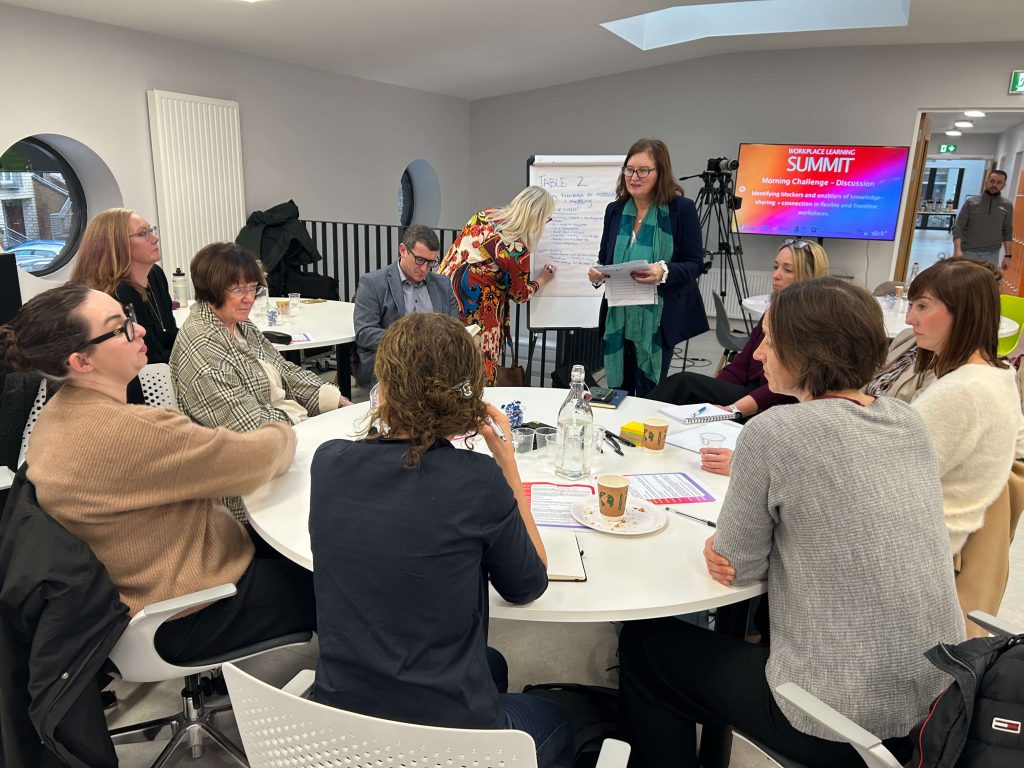
At the Workplace Learning Summit 2025 we tested a simple idea: If you put the right people in the room and ask the right questions, the best expertise won’t come from the stage – it’ll come from each other. Leaders from engineering, medtech, logistics, public service, higher education and tech spent a full day talking honestly about knowledge sharing in the workplace: what’s working, what isn’t, and what needs to change.We recorded the table conversations (with permission), transcribed them, and have been analysing them since. What follows is a synthesis of the big themes and standout lines – and a preview of the playbooks, blogs and practical guides we’ll be publishing over the coming weeks. From “more content” to “better connection” The day opened with a challenge to the old idea that you can fix everything with “more training” or “more content”. Instead of another handbook or course, participants described a different set of priorities: As one participant put it: “We don’t have a knowledge problem. We have a findability and sharing problem.” Across dozens of conversations, four big challenges kept showing up. 1. Capturing in-house know-how before it walks out the door Every organisation seemed to have “that person”: They’re heroes. But they’re also a risk. People talked about organizational knowledge sitting in one person’s head, one old spreadsheet or one local drive. Many of those heroes are close to retirement. When they leave, their knowledge leaves with them. What’s starting to work: The shift is from “write a big manual” to “create a living, searchable knowledge sharing system that people actually use”. 2. Onboarding & mentoring: the first 90 days make or break it Ask someone about their first 90 days in a new job and you get strong reactions. We heard about: Underneath that is a simple truth: onboarding is knowledge management in the workplace at its most human. You’re not just giving people documents; you’re helping them build relationships and confidence. What good looked like in the room: Several organisations are now treating mentoring as part of their leadership and knowledge sharing strategy: mentors get recognition, support and, in some cases, faster progression.Over the coming weeks we’ll be sharing a First 90 Days Onboarding Playbook with templates and checklists drawn directly from these stories. 3. Technology: too many tools, not enough “front door” Nobody needs another system login. Participants listed a familiar stack: LMS, intranet, Teams, Slack, ERP, CRM, shared drives, wikis… each with a different owner and a different login. The result? “I spend more time asking where something is than actually learning from it.” The opportunities we heard about were less “buy more tech” and more “make tech behave better”: In other words, a modern knowledge management platform should feel more like a social space and less like an archive.That’s exactly the space where Slick+ is focused: helping organisations create a simple, social “front door” for sharing best practices in the workplace, capturing improvements and making knowledge findable for everyone. 4. From “lessons learned” to learning in action One frustration came up again and again: “We do ‘lessons learned’ and then make the same mistakes.” People described detailed after-action reports that nobody has time to read, and retros that feel like blame sessions rather than learning conversations. The groups that felt more optimistic were doing things differently: This is where knowledge management best practices become real: when people can see their ideas move from insight to implementation, they’re far more willing to keep contributing.We’ll be turning these patterns into a Knowledge-to-Action Playbook: practical ways to move from “we know this” to “we actually do this”. 5. AI, change & the human side of knowledge management The afternoon turned to knowledge management and AI – and the mood in the room was honest. Yes, generative AI and AI-powered knowledge bases can make it easier to search documents, draft content and answer questions. But people’s first reactions were human, not technical: Participants shared a clear pattern from past rollouts of new tools: A better way, based on the summit discussions: We’ll be publishing an AI & Change 90-Day Guide that captures these insights and turns them into checklists, sample comms and workshop outlines. What happens next: from summit to library of practical guides The summit was deliberately built as a social learning lab. The real value is what we all do next with what we heard. Over the coming weeks, we’ll be sharing a series of resources – all grounded in attendee conversations and group work – including: Each piece will include real quotes, examples and templates you can adapt – whether you’re building a knowledge management system, choosing a knowledge sharing platform, or simply trying to make it easier for people to share knowledge at work. If you’d like to get these as they’re released, make sure you’re: Thank you again to everyone who contributed stories, doubts, experiments and hard-won lessons. You’ve given us a rich foundation to build on – and we’re looking forward to sharing it back with you in ways that are practical, honest and immediately useful.
The Secret to Business Enablement is in Unlocking Your Organisation’s Hidden Expertise*

Have you ever spent far too long trying to find the answer to a simple question?Or been interrupted—again—with the same requests for help from colleagues? These frustrations aren’t just minor inefficiencies. They’re symptoms of a deeper issue: the way organisations struggle to capture and share the knowledge that really matters. It’s a challenge that traditional learning—like generic onboarding modules or classroom-based training—often fails to solve.Today’s businesses need a smarter approach: one that unlocks the hidden expertise within their teams and makes it accessible right when it’s needed most. The Real Problem: Traditional Learning Only Scratches the Surface Think about your organisation’s knowledge like an iceberg. Formal training covers just the visible tip—about 10%. Beneath the surface lies the vast majority: tacit knowledge. This is the contextual, experience-based “know-how” about how things really get done—knowledge that’s rarely documented but critical for business success. When an experienced employee leaves, much of this hidden expertise disappears with them. And it’s costly: studies show organisations lose an average of $430,000 per year due to lost knowledge. Compounding the problem, the shift to distributed work has eroded informal learning—those quick desk-side demos, hallway chats, and casual conversations where so much valuable knowledge used to be shared. Meanwhile, employees are busier than ever. Research by Harvard Business Review found workers spend only 24 minutes per week on formal learning. This drives home the fact that most learning happens informally or “in the flow of work” rather than through dedicated training time In short: formal learning alone isn’t enough.You need a way to capture and make critical knowledge available exactly at the moment of need. A Smarter Way Forward: Building a Business-Ready Knowledge Library This is where contextual, bite-sized video comes in—not because video is trendy or fun to create, but because it’s an incredibly effective way to store and transfer real-world, actionable knowledge. Video allows you to: But the real value isn’t just in creating videos—it’s in building a structured, searchable, and context-relevant knowledge library that your teams can access any time they need help. That’s the problem Slick+ is designed to solve. Slick+ isn’t about encouraging everyone to become content creators. It’s about ensuring that vital knowledge is captured in a way that is useful, relevant, and easy to find and apply—helping employees get their work done faster, better, and more independently. With Slick+, you: In a fast-moving world, the ability to access the right knowledge, at the right time, is a major competitive advantage. The Bottom Line: Enable Your People, Protect Your Expertise By focusing on capturing what really matters—the insights, shortcuts, and real-world processes that drive performance—you create an environment where: And importantly: this approach augments human value. It’s not about replacing expertise with technology—it’s about making human expertise accessible and sustainable. It’s about business enablement. What Next? Ask yourself: Start small, but start!: Pick just one process, workflow, or key piece of knowledge to capture and share in a way that’s quick to access and easy to use. If you’d like to explore how to unlock and protect your organisation’s hidden expertise, we’re offering a free consultation to help you build a sustainable, business-focused knowledge library with Slick+. Let’s help your teams get the job done, better and faster—wherever and whenever they need it. Learn more and book your complimentary consultation today. *This article is based on a keynote talk presented by Slick+ CEO and Co-founder Paul Conneally, at the Learning Technologies Conference and Exhibition (Europe’s largest learning technology conference) on 23 April 2025 at London’s ExCel centre.
How Slick+ Strengthens ESG Reporting and Workforce Sustainability Compliance

Slick+ can be the intelligent backbone of your ESG strategy—enhancing compliance, sustainability, and workforce development, all in one powerful platform. Environmental, Social, and Governance (ESG) reporting is now a critical priority for organizations committed to sustainability. The European Union’s Corporate Sustainability Reporting Directive (CSRD), effective from January 1, 2024, mandates that companies meeting at least two of the following criteria—€25 million in assets, €50 million in turnover, or 250 employees—must disclose their climate risks and societal impacts. While these regulations aim to enhance transparency and drive more sustainable business practices, many organizations face challenges in effectively capturing and reflecting their broader impact. The Slick+ platform goes beyond efficiency and productivity—it also serves as a powerful enabler of corporate ESG strategies, particularly under the ESRS S1 (Own Workforce) standards. Indeed, this has been designed into the DNA of our platform since day zero. How Slick+ Enhances Sustainability Efforts Slick+ provides organizations with an advanced, AI-driven approach to workforce development, knowledge retention, and employee engagement—critical pillars of the Social (S) aspect of ESG reporting. Here’s an example of how Slick+ can drive sustainability impact while supporting regulatory compliance: Slick+ and ESG Reporting: Addressing EU Obligations With corporate sustainability reporting now a regulatory requirement, companies can use Slick+ to demonstrate compliance with ESRS S1 standards and enhance their ESG positioning. Key ESG Reporting Contributions 📌 Training & Skills Development (ESRS S1-13) ✔ Upskills employees through AI-powered, personalized learning.✔ Ensures accessibility of corporate policies via translations, graphics, and digital formats.✔ Automates skills audits and training assessments, improving workforce competency tracking.✔ Client Example: Enables inclusive training programs for night workers and non-native speakers, ensuring all employees stay informed and upskilled. 📌 Worker Engagement (ESRS S1-2) ✔ Provides interactive tools for real-time worker engagement and feedback integration.✔ Centralizes company-wide knowledge exchange, reducing reliance on email-heavy workflows.✔ Educates employees on sustainability initiatives and carbon reduction strategies.✔ Client Example: Keeps employees connected through AI-powered bite-sized learning eliminating silos. 📌 Health & Safety (ESRS S1-14) ✔ Serves as an AI-powered safety hub, making health & safety training more engaging and interactive. 📌 Employee Engagement & Inclusion ✔ Ensures all employees feel connected, improving workforce inclusivity and engagement.✔ Client Example: Strengthens employee connection for remote workers, especially new hires, ensuring they receive equal access to company updates. No more early exits or proximity bias! 📌 ESG Awareness & Sustainability Initiatives ✔ Creates dynamic spaces for employees to engage in sustainability discussions.✔ Raises visibility for corporate sustainability goals through on demand, tailored dashboard reporting. Why Choose Slick+ for ESG Reporting Compliance? Slick+ doesn’t just optimize knowledge exchange and workforce efficiency—it enables companies to prove ESG commitment with tangible, data-driven insights. By integrating AI-powered learning, workforce engagement, and sustainability tracking, organizations can align with EU ESG regulations while fostering a future-ready, digitally empowered workforce. Let Slick+ be the intelligent backbone of your ESG strategy—enhancing compliance, sustainability, and workforce development, all in one powerful platform. For more information and to see how Slick+ can tailor data and analytics for your organization’s commitment to ESG please contact paul@slick.plus