
Watch It, Don't Read It.
Print manuals and static instructions don't fail because people don't care. They fail because reading is the wrong format for learning a task. Dublin City University's VR Lab tested this directly - comparing Slick+ video instructions against traditional written manuals on an unfamiliar technical task.
Book a demo* Independent evaluation by Dublin City University VR Lab, 2026.
Video vs. written instructions, tested head to head
Participants completed the same unfamiliar technical task using either Slick+ video or a traditional written manual. The results weren't close.
Source: Dublin City University VR Lab pilot study.
37% faster task completion
Video users finished in 22 minutes against 35 for text users, on a task neither group had done before.
Every written-instruction user had to double back
100% of the written group re-checked instructions mid-task, versus just 25% of video users.
Confidence, not just speed
4.1 out of 5 for video users versus 2.7 out of 5 for written-instruction users.
No production team. No content budget. Just your own people.
The DCU results aren't from polished studio content - they're from short videos made by ordinary colleagues. That's the model.

Someone who knows the task records it
On a phone, in a few minutes. No script, no studio - just the person who actually does the job showing how it's done.
It's organized into a playlist or series
Grouped by role, task, or onboarding stage, so the next person sees exactly what's relevant to them - not everything.
Reviewed before it goes live
A manager checks it before it's published, so what's shared is accurate and approved - not just whatever got filmed first.
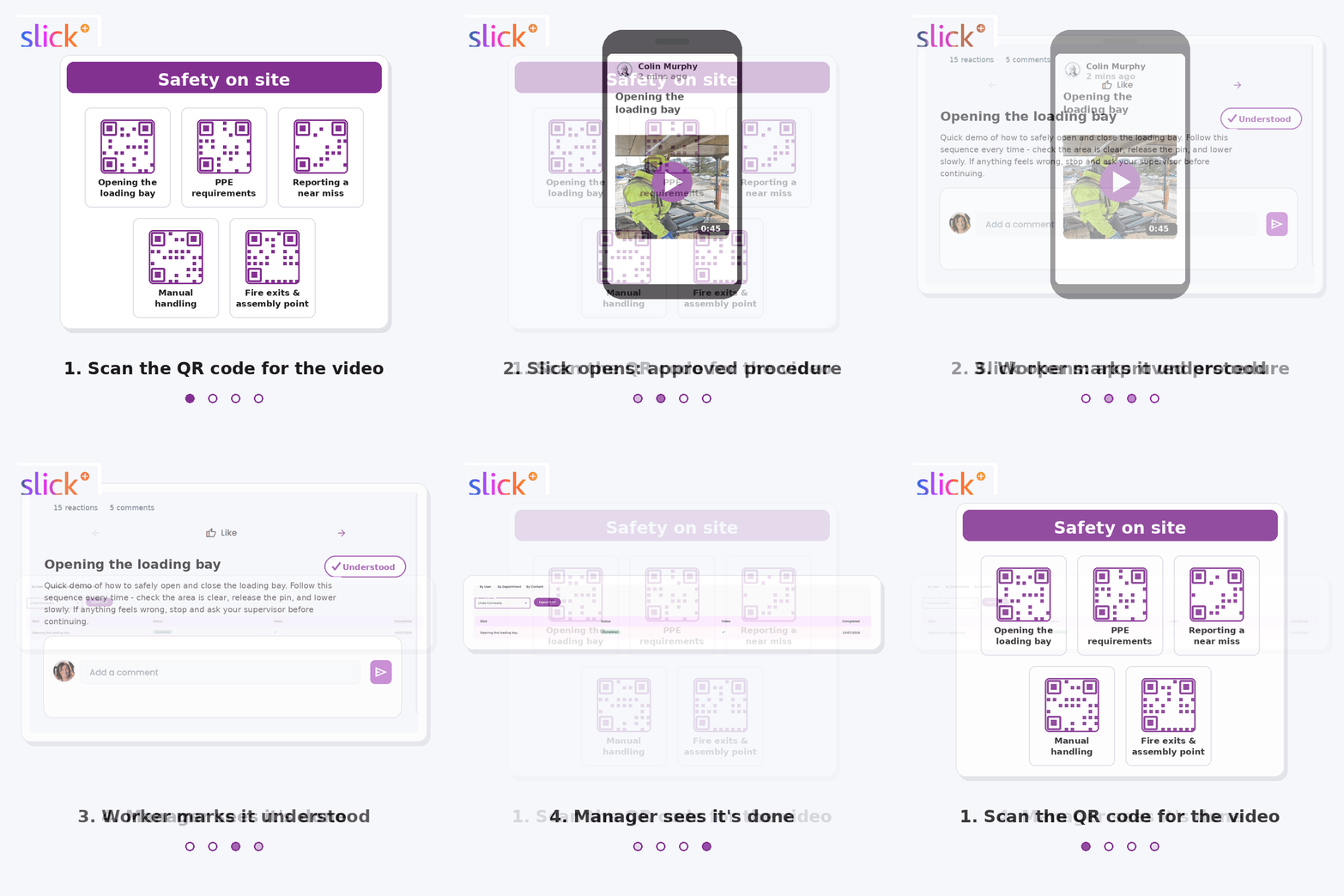
Found in seconds, right when it's needed
Searchable on mobile, QR code, or kiosk - at the point of work, not buried in a binder or shared drive.
This is the same reason peer-filmed video outperforms studio-produced training in the DCU pilot - content made by the people doing the work builds more trust and gets watched more than anything more "produced."
Video only helps if people can find the right clip when they need it
Playlists & series
Onboarding series, role-specific playlists, and update/compliance series so people see what's relevant to them.
Search
Find the right clip quickly instead of scrolling a shared drive or a long document.
Admin analytics dashboard
See what's actually being watched, rewatched, and asked about, by team or topic.
Organizations already using video over print
"Given the very specific nature of our work, mentoring is a strategic imperative and Slick+ allowed us to unlock the power of mentoring at scale while reducing our reliance on external training."
"The ability for interns to onboard at their own pace and refer back to the videos reduced the burden on our full-time staff and significantly improved the quality of the work we received from this cohort."
Global Logistics Company

Scaling across new European sites while integrating two acquisitions, this company replaced print-heavy SOPs with Slick+ video.
"We cannot drown people in hundreds of pages of dry manuals - and I do not think we could scale the way we want to without Slick! It's transformed how we train, how we communicate, and how we move as one team."
Still training on print manuals?
See what the DCU study means for your onboarding time and error rate.


